

Neither is better for everyone. Invisalign (clear aligners) suits many adults and teens with mild to moderate crowding or gaps who want a removable, discreet option and will wear it 20 to 22 hours a day. Braces are fixed and can handle a wider range of cases, including complex bite problems. An examination of your teeth, gums and bite decides which one fits.
Key takeaways
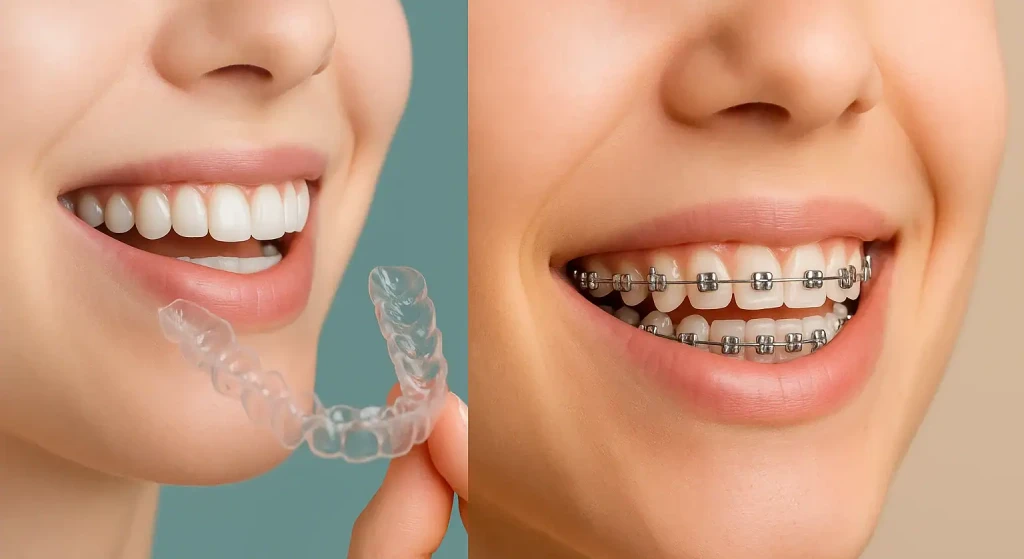
- Look: aligners are nearly invisible, metal braces are obvious, and ceramic braces sit in between.
- Removable: aligners come out for eating and cleaning. Braces stay on.
- Wear time: aligners only work if worn 20 to 22 hours a day. Braces work all day without effort.
- Complex cases: braces are usually the safer choice for severe crowding or large bite problems.
- Duration: many aligner cases take about 6 to 18 months and braces about 12 to 24 months, depending on the case.
- Retainers: you need them after either treatment.
Invisalign vs braces at a glance
| Feature | Invisalign (clear aligners) | Metal braces | Ceramic braces |
|---|---|---|---|
| Visibility | Almost invisible | Clearly visible | Less visible than metal |
| Removable | Yes | No | No |
| Best suited for | Mild to moderate crowding, gaps, selected bite issues | Complex or severe cases | Adults wanting a discreet fixed option |
| Typical duration | About 6 to 18 months | About 12 to 24 months | About 12 to 24 months |
| Eating | Remove aligners to eat | Avoid hard and sticky foods | Avoid hard and sticky foods |
| Cleaning | Brush and floss as normal | Extra care around brackets | Extra care, ties can stain |
| Depends on patient wear time | High | None | None |
| Check-up visits | Often every 6 to 8 weeks | Often every 4 to 8 weeks | Often every 4 to 8 weeks |
Duration and visit frequency are general ranges. Your own plan depends on your teeth and bite.
Is Invisalign better than braces?
Not always. Invisalign is better for people who want a discreet, removable option and have a case simple enough for aligners. Braces are better when the bite or crowding is complex, or when consistent wear is hard to guarantee. The deciding factors are your bite, your habits and your gum health.
What is the difference between Invisalign and braces?
Invisalign uses a series of custom clear plastic trays. Each tray moves the teeth a small step, and you change trays every one to two weeks. Braces use brackets bonded to the teeth and joined by a wire, which a dentist adjusts at regular visits. Brackets can be metal or tooth-coloured ceramic.
Which cases suit Invisalign, and which need braces?
Invisalign usually fits:
- Mild to moderate crowding
- Gaps between teeth
- Some bite concerns
- Adults who want discretion and will wear aligners consistently
Braces usually fit:
- Severe crowding
- Significant bite correction
- Rotated or tilted teeth
- Patients whose daily wear is hard to rely on
Which is faster, Invisalign or braces?
Speed depends on the case, not the product. Many mild cases finish in under a year, while complex ones can take 18 to 24 months or longer. Aligners slow down or go off track if they are not worn 20 to 22 hours a day, whereas braces keep working whether or not you remember.
Which is more comfortable?
Both cause pressure for the first few days after a new tray or an adjustment. Braces can rub the cheeks and lips until you adapt, and orthodontic wax helps. Aligners are smooth but feel tight when you switch trays. Pain that is sharp or does not settle should be reviewed by your dentist.
Which is easier to clean and eat with?
Aligners are easier. You take them out to eat, brush and floss as usual, and clean the trays. Braces trap food around brackets and wires, so they need careful brushing, interdental brushes, and avoiding hard or sticky foods.
Who may not be a good candidate for Invisalign?
- People with severe crowding or large bite discrepancies
- Anyone with untreated gum disease or active decay (these need treatment first)
- Patients who cannot wear aligners 20 to 22 hours a day
- Teeth that need complex rotation or vertical movement
Suitability is confirmed at an examination, not before it.
What affects the price difference between Invisalign and braces?
Clear aligners generally cost more than metal braces. The final fee depends on how complex the case is, how long treatment takes, the type of brackets or number of aligners, refinements, retainers and review visits. For fees specific to our clinic, see the Invisalign treatment page and the braces treatment page.
Do you need a retainer after Invisalign or braces?
Yes. Teeth tend to drift back after treatment, so retainers hold the result. Your dentist will advise whether you need fixed or removable retainers and for how long.
How do you choose between Invisalign and braces?
Ask yourself five questions:
- How complex is my bite? (complex cases lean towards braces)
- Can I wear aligners 20 to 22 hours a day, every day?
- How visible am I comfortable with my treatment being?
- Are my teeth and gums healthy enough to start now?
- Can I attend regular check-ups?
A dentist can answer the first and fourth properly after an examination.
What is the next step?
If you want a professional opinion, read about Invisalign treatment or braces treatment, or book a consultation with Thooya Oral Wellness.
Frequently Asked Questions
1. Is Invisalign as effective as braces?
For suitable mild to moderate cases, yes. For complex cases, braces are often more predictable.
2. Can Invisalign fix bite problems such as an overbite?
Some bite problems can be treated with aligners, depending on severity. Significant bite correction is often planned with braces.
3. Can I eat normally with Invisalign?
Yes. You remove the aligners to eat, then brush before putting them back in.
4. What happens if I do not wear my aligners enough?
Treatment slows down or goes off track, and you may need extra aligners or more time.
5. Are braces or aligners more painful?
Both cause temporary pressure after a new tray or adjustment. Neither should cause severe pain.
6. Can adults get braces or Invisalign?
Yes. Adults can have either, as long as their teeth and gums are healthy enough for tooth movement.